
We Burned $500K Building an In-House Editing Team. Here's What We Learned.
We lost $500K and almost had to lay off our team. Here's the hard truth about in-house vs. remote video editing teams for ecommerce brands.
The Mistake That Almost Ended Us
We were days away from having to lay off most of our team.
We had six figures in debt. We'd burned over $500,000 in investment into a team structure that nearly destroyed everything we'd built.
The painful part? We thought we were doing the right thing the whole time.
This is the story of our biggest operational mistake — building a large in-house video editing team — and what it cost us. We're sharing this because we'd rather you learn from our failure than repeat it yourself.
If you're building a creative team for a DTC ecommerce brand, managing video ad production at scale, or trying to figure out whether to hire in-house or go remote for editing, this one's for you.
How It Started
Like a lot of agencies, we started lean. Our first hire was a video editor based overseas. Cost-effective, skilled, easy to work with.
Then we hired six more before we ever brought on anyone in a different role.
Eventually, we had 20 remote editors overseas. Things were running well. Then we made our first big mistake: we decided to "upgrade" by hiring our first in-house editor.
On paper, it made sense.
- Easier communication
- More collaborative
- Able to handle emergency edits
So we kept going. We hired four or five more in-house editors — many at intern wages for 90-day trials. This was a mistake inside a mistake.
They were getting their experience on our dime. And it was costing our senior team members enormous amounts of time to coach and review their work.
Even with solid training systems in place, we've learned it's almost always better to hire someone already skilled enough to do the work of five.
A couple of those interns did turn into senior leaders — and we're grateful for that. But the overall direction we were heading was wrong, and we didn't see it until it was almost too late.
A year and a half in, here's where we landed:
- 10 in-house editors
- 73 remote editors
Can you guess which one was the mistake?
Why In-House Editing Sounds Good (But Isn't)
Here's the thing about in-house editing teams — the benefits sound great until you run the actual math.
"You'll get better communication."
Sure. But is that worth paying six times more per editor?
"You'll get faster turnaround."
Marginally. But emergencies in creative production are almost always the result of poor planning, not a lack of proximity. And high-priority projects? Remote editors can handle them just as well.
"You'll have more control."
You will. But control doesn't generate revenue. Output does.
The narrative around in-house teams sounds logical. But logic without data will cost you a lot of money. Research consistently shows that remote workers are 35–40% more productive than their office-based counterparts — and in creative production roles, this gap tends to be even more pronounced.
The Numbers That Don't Lie
This is where things got brutal for us. When we finally took a hard, honest look at the data, the swing was staggering.
Cost per edit — US vs. overseas:
A skilled editor in the US adds $100–$120 more to the bottom line per edit compared to a remote editor of the same skill level overseas. At scale — producing hundreds of pieces per month — that number is devastating.
Monthly output comparison:
In-House Team
Remote Team
Monthly Output
~25%
~75%
Monthly Cost
~$40,000
~$13,500
The remote team was producing 3x the output at ⅓ the cost.
When you add it all up, that's a 600% swing in cost efficiency.
We had let a bad senior leader on the in-house side manipulate those numbers for months, making it look like parity when it was anything but. Once we dug into the actual data, the truth was undeniable.
And look — we take full responsibility. The team's success or failure is on leadership. If different decisions had been made, this never would have happened. But it did, and here's what we learned.
What We Actually Learned
It's been over a year since we went to zero in-house editors.
Here's what we know now:
Timezones aren't the problem you think they are. You just need Editing Directors — senior team members — who share a timezone with the rest of their direct team. The work gets done while you sleep. It's ready when you wake up. That's actually a feature, not a bug.
Emergencies aren't real. Almost every "emergency" in creative production is the result of poor workflow management. When your systems are tight, you don't need someone physically in the building.
Remote teams can handle your most important clients. This was a fear we had for years. It was unfounded.
Quality remote editors exist at scale. Over the past four years, we've hired hundreds of editors and built a tight process for sourcing, qualifying, and onboarding them — often up to speed within a week.
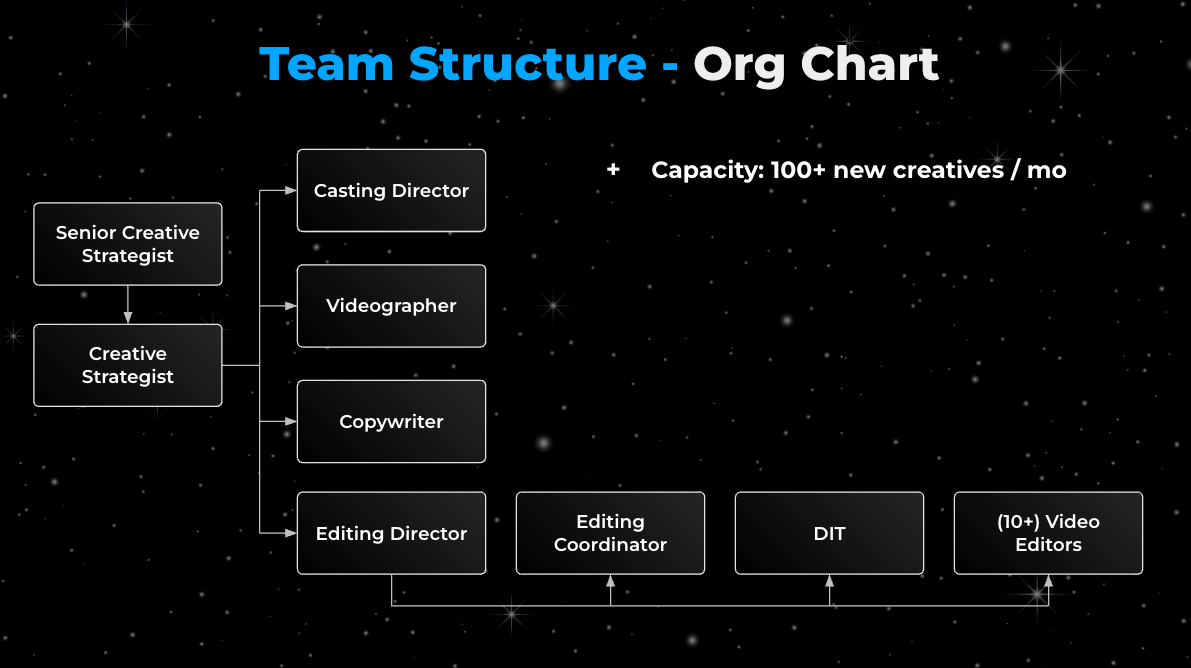
The result? Our editing team now has the highest efficiency ratio we've ever had. They produce 519+ original pieces per month, plus 2–3x that in variations. That's about 1.5x more output than the previous year — with team costs at one-third of what they were.
How to Build a Remote Editing Team That Works
If you're ready to build a high-output remote editing team — or rebuild one like we did — here's the framework that works for us:
1. Hire experienced, not trainable. Stop hiring for potential if you're producing at volume. Hire people who can do the work on day one. The cost of training is almost always higher than you think.
2. Build a clear qualification process. Know exactly what "good" looks like before you post a job. Have test projects. Have scoring rubrics. Don't wing it.
3. Systemize onboarding. We can get an editor fully operational on our systems within a week. That's only possible because the process is documented, tested, and repeatable. HubSpot's guide to scaling marketing teams is a great reference for building scalable team infrastructure across any creative function.
4. Install Editing Directors. Don't skip this. Senior editors who oversee a pod of 5–8 editors are the glue. They handle quality control, flag issues early, and own the relationship between the creative team and the strategy layer.
5. Maximize output per editor. Track output per editor per month. Know your baseline. Build toward it. Our benchmark is around 519+ originals monthly across the full team, with each editor contributing a defined quota.
6. Use async communication as a feature. Stop thinking of time zone differences as a liability. Build workflows that leverage them. For creative production — especially for done-for-you video ads and UGC content — async production cycles let you scale faster without adding management overhead.
For more on building lean, high-performing remote creative teams, Iconik's remote video editing guide is worth a read.
The Bottom Line for Ecommerce Brands
If you're a DTC ecommerce brand or a performance creative agency trying to scale video ad production, this is the direct answer:
In-house editing teams are almost never worth it.
Not because in-house talent is bad. But because the math simply doesn't work. Six times the cost for a marginal speed increase and a small communication benefit is not a trade worth making.
The brands and agencies winning right now are running lean, remote-first creative teams with tight systems — and they're producing more content, spending less, and getting better results.
We learned this lesson the hard way. $500K, near lay-offs, and about two years of pain taught us what the data would've told us on day one.
Don't guess. Build internal creative team structures based on math, not intuition.
If you want to see how we've structured VisCap's production system — and how it could work for your brand or agency — book a free strategy call with our team. We'll show you exactly how we run 519+ original pieces per month with a fully remote team and a fraction of the overhead.
Or, if you want to build this yourself, check out VisCap AI — our software platform that gives you access to our top-performing creative frameworks every month.
Tyler Stephens is the founder of VisCap Media, a performance creative agency that has produced video ads for DTC ecommerce brands spending $500K–$10M/month on paid social. VisCap has spent over $100M managing ads and produced thousands of winning UGC video ads across beauty, health, fashion, and supplement verticals.
Join The Dark Side Of Video Ads
